
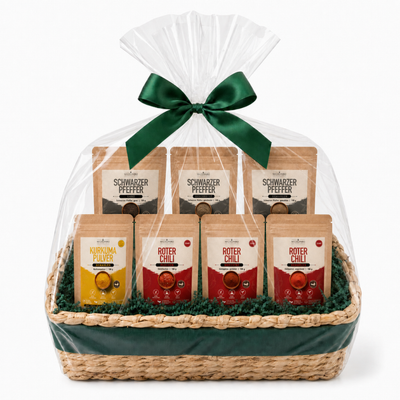


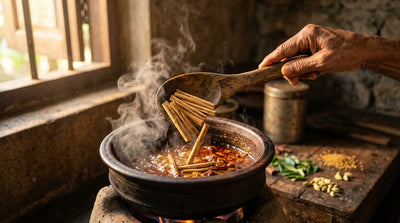
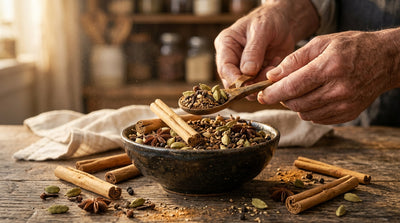
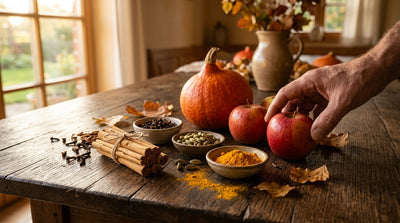

Making your own barbecue spices means, in concrete terms: three basic building blocks (salt, sweetness, aroma), a mixing ratio of 8:3:1 for the classic BBQ rub and around 10 minutes of effort per 150 g of rub. If you mix your own, you control every ingredient, save up to 80% compared with ready-made blends according to our calculation, and get a noticeably fresher flavour. In tests in 2024, the consumer advice centre Verbraucherzentrale Brandenburg found ready-made blends with up to 50% sugar and 24% salt - at prices of 116 euros per kilo (Verbraucherzentrale Brandenburg, 2024).
We show you three rub recipes to mix yourself: a classic BBQ rub with a smoky crust, an oriental grill mix modelled on North African tradition and a Sri Lankan curry rub with roasted spices from our direct import. You will also learn the science behind good barbecue flavour (the Maillard reaction from 140 °C), marinating-time tables based on USDA recommendations and tips for vegetarian food on the grill. A study by Sepahpour et al. (2018) also shows that herb marinades can reduce the formation of heterocyclic amines during grilling by up to 94.7% - an aspect that home-mixed rubs make deliberate use of.
At a glance
Why make barbecue spices yourself?
Ready-made spice blends from the supermarket sound convenient. But a look at the list of ingredients is sobering: according to the German Food Code (Deutsches Lebensmittelbuch), seasoning salts only have to contain 15% real spices (BMEL guidelines, 2024). The rest is made up of salt, sugar, sunflower oil and flavour enhancers. So-called "seasoning mixes" do not have to contain any real spices at all and sometimes consist mainly of glutamates (E 620-E 625), yeast extracts and maltodextrin. A Stiftung Warentest market analysis of 22 well-known spice products found that many products marketed as "spice" would legally have to be declared as spice preparations (Stiftung Warentest, 2025).
Home-mixed barbecue spices have three clear advantages:
Freshness: Ground spices lose a large part of their essential oils within 6 to 12 months, because the cell structure broken open during grinding offers more surface area for oxidation (Fachverband der Gewürzindustrie, 2024). Whole spices, by contrast, keep for 2-4 years. If you grind your rubs fresh, you get a more intense flavour than any product on the shelf - according to Shobana and Naidu (2000), up to 70% of the bioactive compounds are lost when pre-ground spices are heated.
Control: You decide the salt content, the heat and whether sugar goes in. No hidden additives, no E-numbers, no anti-caking agents. Perfect for people with allergies and anyone who wants to know what ends up on the plate.
Cost: Ready-made blends cost on average three to four times as much as the same quantity of home-mixed spices. A home-mixed portion of rub comes to around 30-50 cents. If you buy in larger quantities and mix several rubs, you save up to 80% compared with branded products.
Important
The consumer advice centre Verbraucherzentrale Brandenburg examined ready-made spice blends and found a product with 50% sugar, 24% salt and a price of 116 euros per kilo. Bought individually, the ingredients would have cost only a fraction of that. One manufacturer received a formal warning for misleading marketing.
How is BBQ flavour created chemically?
The typical BBQ flavour is created by the Maillard reaction from around 140 °C, in which amino acids and reducing sugars are converted into pyrazines, furans and melanoidins (Liu et al., 2022). A good rub supplies the building blocks for this reaction and determines which flavour profiles dominate - nutty and roasted, sweet and caramelised, or tangy and spicy.
Maillard reaction: why crust tastes good
The Maillard reaction is a chemical reaction between amino acids and reducing sugars. It starts at around 140 °C and produces melanoidins as well as aroma-active pyrazines - the compounds that give fried and grilled food its characteristic taste and golden-brown colour (Goldwyn, AmazingRibs.com 2024). A rub supplies the fuel for this reaction: salt draws out moisture, protein breakdown products from garlic and onion powder provide additional amino acids, and small amounts of sugar speed up crust formation. The result is the typical bark, an aromatic crust 1-2 mm thick.
Healthier grilling: how spices reduce HCAs
When meat is grilled, heterocyclic amines (HCAs) form at core temperatures above 150 °C; according to the German Federal Institute for Risk Assessment, these are considered potentially carcinogenic (BfR, 2016). This is where spices show their quiet strength: a herb marinade of turmeric and lemongrass reduces HCA formation in beef by up to 94.7% (Sepahpour et al., 2018). Rosemary extract inhibits the HCA variant MeIQx by 91.7% and PhIP by 85.3% (Puangsombat and Smith, 2010). The active compounds carnosic acid, curcumin and linalool scavenge free radicals before they react with amino acids to form HCAs - a further argument for home-mixed rubs with a high spice content.
The role of sugar
Brown sugar in a BBQ rub caramelises from around 160 °C on the surface of the meat and, together with the Maillard products, forms the sweet, smoky bark. Sugar is suited to low-and-slow grilling at 110-140 °C of indirect heat. Over direct heat above 180 °C, sucrose burns quickly and tastes bitter. If you grill over charcoal at 250 °C or more, you should halve the sugar content or leave it out altogether. Dark brown sugar (muscovado, dark brown sugar) has a higher molasses content and gives the rub depth without increasing the sweetness.
Roasting: how to get the most out of spices
Roasting whole spices in a dry pan for 2-4 minutes is the decisive flavour boost. The heat makes the cell walls of the seed coats brittle, drives out residual moisture and lets the essential oils evaporate and blossom. When cumin is roasted, cuminaldehyde forms, the main carrier of its typical aroma. Coriander becomes sweeter and more floral because linalool is released - according to Al-Khayri et al. (2023), this terpene makes up between 40.9% and 79.9% of coriander oil. Capsanthin and capsorubin in paprika powder additionally bring an antioxidant effect to the rub (Maeda et al., 2021).
Practical tip
Every spice has a different smoke point. Roast spices individually or in groups with a similar oil content. Cumin and coriander go well together, as do mustard seeds and fenugreek. Peppercorns and fennel each need their own roasting round.
Pestle and mortar or grinder?
A pestle and mortar breaks open cell structures by mechanical crushing and rubbing. This releases essential oils more intensely than a spice grinder, which cuts evenly. For rubs we recommend the pestle and mortar: the irregular grain gives the rub texture and character. Use the rub promptly after grinding - freshly pounded spice loses intensity within minutes through oxidation.

What belongs in every good barbecue blend?
Every good rub follows a modular principle of five elements: salt, sweetness, heat, smoke and aroma. The tried-and-tested basic formula for BBQ rubs is the 3:2:1 ratio - three parts paprika, two parts salt, one part black pepper. Building on this, you vary the aromas, sweetness and heat. According to the Sri Lanka Export Development Board (2024), black pepper from the highlands of Sri Lanka, for example from the Galle region, contains particularly high levels of piperine and has a floral, citrus-like aroma profile - a difference in quality that we at MrCOLOMBO secure through direct import.
| Element | Function in the rub | Examples |
|---|---|---|
| Salt | Flavour enhancer, moisture regulation | Sea salt, fleur de sel, coarse rock salt |
| Sweetness | Caramelisation, balancing bitterness | Brown sugar, coconut blossom sugar, honey powder |
| Heat | Depth and kick, saliva production | Black pepper, chilli, cayenne |
| Smoke | BBQ character, depth | Smoked paprika powder (Pimentón de la Vera) |
| Aromas | Complexity, identity of the blend | Garlic, coriander, Ceylon cinnamon, turmeric |
An important distinction: smoked paprika powder (Pimentón de la Vera) from Extremadura in Spain is slowly dried over holm oak wood and then ground. There are three varieties: Dulce (mild and sweet), Agridulce (bittersweet) and Picante (hot). For a classic BBQ rub, Dulce is the best choice - it brings smoky depth without heat.
Rule of thumb for use: About 2 tablespoons of rub per 500 g of food. The rub should support the natural flavour of the food, not mask it. You will find more information on recognising good spice quality in our guide.
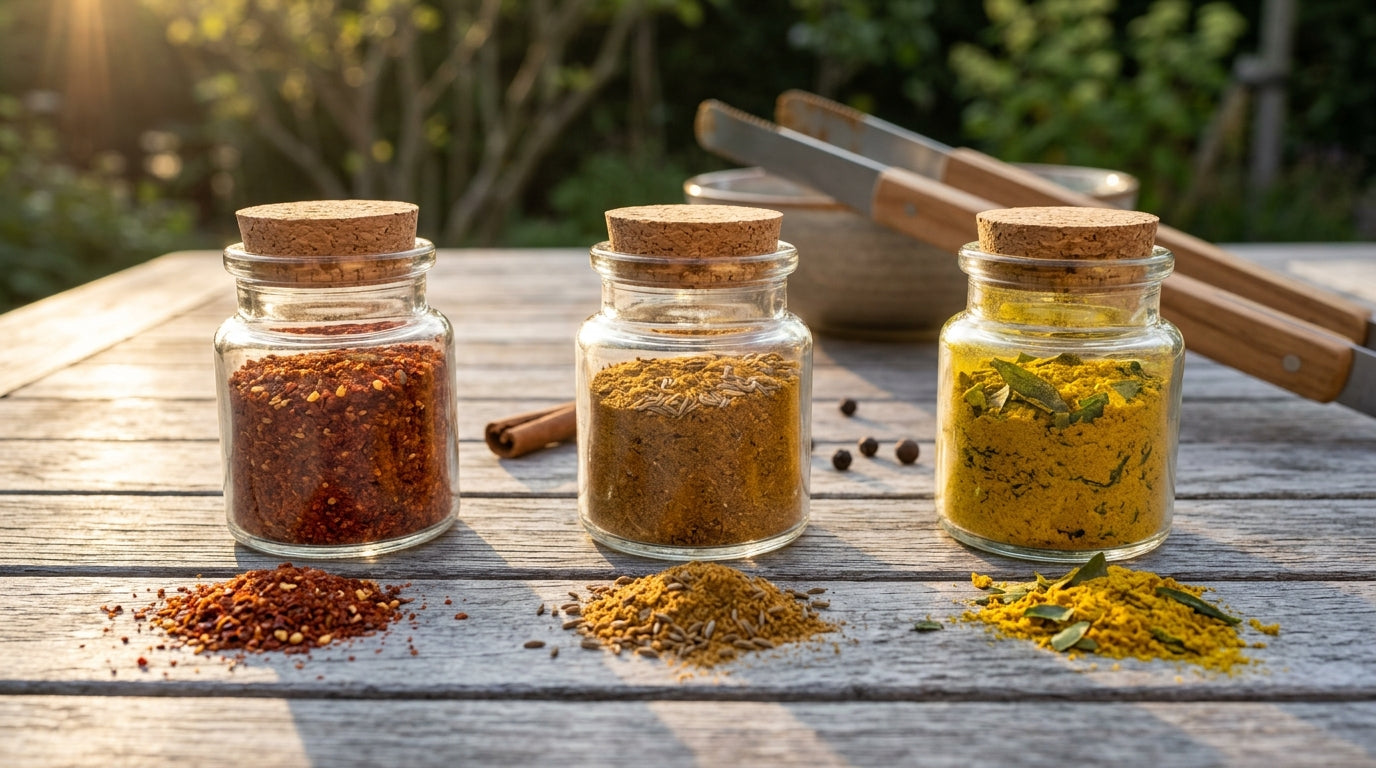
Recipe 1: Classic BBQ rub
The all-rounder for steaks, ribs, chicken and grilled vegetables. This recipe follows the tried-and-tested 8:3:1:1 ratio - eight parts sugar, three parts salt and two parts mixed spices. That sounds like a lot of sugar, but it caramelises almost completely on the grill at 160-180 °C and forms the smoky-sweet bark that makes good BBQ. The smoked paprika powder provides capsanthin and capsorubin as natural antioxidants (Maeda et al., 2021), while garlic granules are heat-stable and keep their flavour even over direct heat - fresh garlic, by contrast, loses its allicin from as low as 60 °C (Bhatwalkar et al., 2021).
Ingredients (makes approx. 150 g)
4 tbsp brown sugar (dark, for its higher molasses content) | 3 tbsp smoked paprika powder (Pimentón Dulce) | 1.5 tbsp sea salt | 1 tbsp black pepper, freshly ground | 1 tbsp garlic granules | 1 tsp onion powder | 1 tsp cayenne | 1 tsp oregano (dried) | 1/2 tsp mustard powder
Preparation
Mix all the ingredients well in a bowl. Fill into an airtight jar and label it with the date. Apply generously to the food and let it work in for at least one hour - overnight in the fridge gives the most intense crust. The brown sugar caramelises at 160-180 °C on the grill and, together with the meat juices, forms a complex, smoky-sweet bark.
Practical tip
For gas grill users: do not go above 200 °C, otherwise the sugar will burn. Alternative for fans of high-heat grilling: leave out the sugar and replace it with 1 tbsp of additional sweet paprika powder and a pinch of Ceylon cinnamon.
Recipe 2: Oriental grill mix
Warm, earthy aromas modelled on North African tradition - inspired by ras el hanout, the "crown of the spice shop". The name comes from Arabic and stands for the best blend a spice merchant has to offer. Traditionally, a ras el hanout contains up to 30 different spices. Our grill version concentrates on the ten most important ones.
Ingredients (makes approx. 120 g)
2 tbsp coriander seeds, roasted and ground | 2 tbsp cumin, roasted and ground | 1 tbsp paprika powder (sweet) | 1 tbsp sea salt | 1 tsp black pepper | 1 tsp turmeric | 1/2 tsp Ceylon cinnamon | 1/2 tsp ginger (ground) | 1/2 tsp chilli flakes | 1/4 tsp cloves (ground)
Roasting tip
Roast the coriander seeds and cumin as whole seeds for 2-3 minutes over medium heat in a dry pan. Swirl the pan regularly. As soon as they smell fragrant and brown slightly, tip them straight onto a plate (they carry on roasting in the hot pan). Let them cool, then grind in a pestle and mortar. Roasting activates the cuminaldehyde in cumin and the linalool in coriander - the main carriers of the aroma.
Turmeric brings not only the golden colour but also earthy depth to the mix. In combination with black pepper, the piperine it contains can increase the plasma concentration of curcumin by a factor of 20, according to a pharmacokinetic study (Shoba et al., 1998). Piperine also increases the bioavailability of other fat-soluble plant compounds such as beta-carotene by around 60% (Tripathi et al., 2022). If you want to learn more about the properties of turmeric, you will find all the details in our guide.
Important regarding Ceylon cinnamon: We deliberately use Ceylon cinnamon instead of cassia cinnamon. Cassia contains 2-7% coumarin, Ceylon only 0.004-0.02% - that is around 350 times less. In 2008, and confirmed in 2012, the EFSA set a tolerable daily intake (TDI) of 0.1 mg of coumarin per kilogram of body weight (EFSA, 2012). With regular consumption, Ceylon cinnamon is considerably safer - a person weighing 70 kg reaches the limit with just 2 g of powdered cassia cinnamon, whereas with Ceylon cinnamon the corresponding amount is around 700 g.

Recipe 3: Sri Lankan curry rub
This rub is based on the spice tradition of Sri Lanka - according to the Export Development Board the tenth-largest spice exporter in the world, with an export volume of USD 449.91 million and 40,302 tonnes per year (EDB Sri Lanka, 2025). What makes Sri Lankan spice blends special is the trinity of curry leaves, mustard seeds and fenugreek - they give the rub a tangy, complex undertone that no Western counterpart achieves. In Sri Lanka, a distinction is made between roasted curry powder for meat and fish dishes and unroasted for vegetable curries. For the grill we use the roasted variety.
Our spices for this rub come from three specific regions: Ceylon pepper from the hills around Galle in the south, cardamom from the Knuckles Range area in the Central Province, and curry leaves and turmeric from the region around Matale. This geographical diversity is no coincidence - each spice needs a different microclimate. Cardamom grows at 600-1,200 metres above sea level in humid, shady mountain forests, pepper in the warm lowlands on bamboo frames or coconut palms. We know our partners' plantations personally and know when the pepper is harvested - precisely when the single green berry at the bottom end of the spike begins to turn yellow. This harvest time determines the piperine content of the finished pepper.
Ingredients (makes approx. 130 g)
2 tbsp coriander seeds | 2 tbsp cumin | 1 tbsp turmeric | 1 tbsp sea salt | 1 tsp black pepper (whole) | 1 tsp black mustard seeds | 1 tsp fennel seeds | 1/2 tsp Ceylon cinnamon | 1/2 tsp cardamom (seeds from the pod) | 1/2 tsp chilli flakes | 1 tbsp dried curry leaves (optional) | 1/2 tsp fenugreek seeds
Preparation according to the traditional method
In Sri Lanka, each spice is roasted individually, because each has a different moisture content and smoke point. For home use, this simplified method is enough: first dry the curry leaves over medium heat in the dry pan until they turn dark green and brittle - careful, they spit easily. Set aside. Then roast the coriander, cumin, peppercorns and fennel together for 2-4 minutes until they smell fragrant and brown. Swirl the pan regularly. Roast the mustard seeds and fenugreek separately for 20-40 seconds until the mustard seeds start to pop. Let everything cool completely on a plate. Mix in the dried curry leaves. Grind to a powder in a pestle and mortar or spice grinder. Stir in the turmeric, cinnamon, cardamom, chilli flakes and salt.
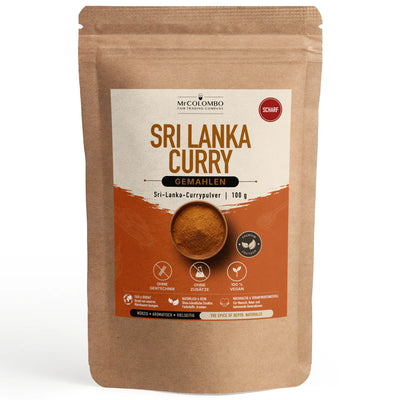
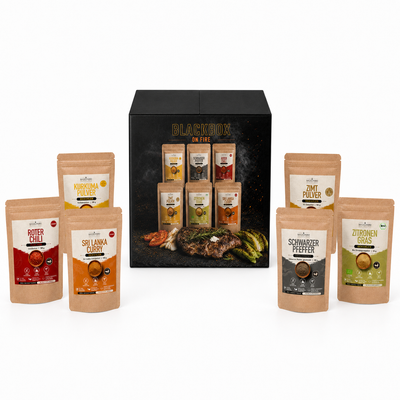
Shortcut: Take our Sri Lankan Curry Mix as a base and extend it with salt and chilli flakes to make a grill rub. Particularly suited to chicken, fish, prawns and tofu. More about the spice tradition of Sri Lanka in our article.
How long does a rub need to work in?
A rub needs time to do its job - the minimum is one hour, ideally 4 to 12 hours in the fridge, depending on the type of meat. Salt penetrates the surface of the meat, draws in moisture and dissolves muscle proteins, which improves the crust. The US Department of Agriculture recommends always keeping marinated meat in the fridge at a maximum of 4 °C and never at room temperature (USDA FSIS, 2024). After 48 hours, the salt can already break down the meat fibres too much and make the meat mushy - 24 hours should therefore be the upper limit.
| Food | Dry rub | Wet marinade | Recommended rub |
|---|---|---|---|
| Beef (steak) | 1-12 hrs | 4-12 hrs | BBQ rub |
| Beef (ribs) | 4-24 hrs | 8-24 hrs | BBQ rub |
| Chicken | 1-8 hrs | 2-8 hrs | Oriental or curry |
| Fish / prawns | 15-30 min | 30-60 min | Curry rub |
| Tofu / halloumi | 1-4 hrs | 2-6 hrs | Oriental or curry |
| Vegetables | 15-30 min | 30-60 min | All three |
How do you season vegetarian food for the grill properly?
Rubs are not just for meat. With halloumi, tofu and firm vegetables in particular, the right spice blend makes the difference between "grilled cheese with salt" and a proper main course. The order matters: with tofu, marinate first without oil, and only brush with oil shortly before grilling - a study on bioavailability shows that fat-soluble flavour compounds such as curcumin and capsaicin only unfold their full flavour effect with fat (Tripathi et al., 2022).
Halloumi with oriental grill mix
Cut the halloumi into slices 1 cm thick, drizzle with olive oil and rub in the oriental grill mix evenly. Leave to rest in the fridge for 30 minutes. Grill on both sides for 2-3 minutes until golden brown. The combination of cumin, coriander and cinnamon harmonises perfectly with the mild salty taste of halloumi.
Tofu with Sri Lankan curry rub
Cut plain tofu (firm) into steaks 2 cm thick and pat dry thoroughly. Mix the curry rub with a little lime juice and soy sauce and turn the tofu in it. Important: do not add oil to the marinade, as it seals the pores of the tofu and stops the flavour penetrating. Marinate for at least 30 minutes to 1 hour, then grill for 10-15 minutes on each side.
Vegetable skewers with all three rubs
Cut courgettes, peppers, mushrooms and red onions into chunky pieces. Divide between three bowls and toss each with a different rub and a little olive oil. Leave for 15-30 minutes, thread onto skewers and grill. This way you get three different flavours in one barbecue evening - perfect for finding out with your guests which rub goes down best.

Your barbecue season, your spices
Making barbecue spices yourself is not a chore - it is an upgrade. In ten minutes you can mix a rub that beats any ready-made blend: fresher aromas, no additives, full control over salt content and heat. The science behind it is simple: freshly ground spices contain more essential oils, the Maillard reaction on the grill turns them into complex aromas, and the right resting time gives the rub the chance to unfold its potential.
Start with the classic BBQ rub for steaks and ribs. Try the oriental mix on halloumi or lamb chops. And for something special: the Sri Lankan curry rub brings aromas to the grill that you will not find in any ready-made blend - roasted coriander, curry leaves and Ceylon cinnamon straight from Sri Lanka.
If you want to go deeper: in our article on cryogenic grinding of spices we explain why the grinding method and freshness determine the aroma. And our guide to organic spices shows why origin and cultivation method influence the taste on the grill.


