



Does cinnamon go with meat, curries and braised dishes? Yes: in at least five international cuisines, cinnamon is a firm part of the basic savoury seasoning, from Persian lamb stews to Sri Lankan coconut curries. The reason lies in aroma chemistry: cinnamaldehyde, the main component of cinnamon's aroma, reaches an aroma value (odour activity value) of 935 in cinnamon bark oil, the highest measured value of all the compounds it contains, and at the same time directly activates the sweet receptor T1R3 on the tongue (bioRxiv preprint, 2025).
That explains why a pinch of cinnamon lends braised dishes a rounded, almost caramel-like depth without the dish tasting sweet. At MrCOLOMBO we import Ceylon cinnamon directly from smallholder cooperatives in Sri Lanka's Central Province, including the growing areas around Matale and Kandy, where the true cinnamon tree (Cinnamomum verum) forms, under a tropical climate, the thin, multi-layered bark that distinguishes it from the thicker cassia bark. This article presents five savoury cinnamon recipes from Persia, Morocco, China, Sri Lanka and North India and explains when the cinnamon stick goes into the pot and when it has to come out again.
Short answer
Does cinnamon belong in savoury dishes? Yes - from Persian lamb stews to Sri Lankan curries, cinnamon is part of the basic savoury seasoning in at least five international cuisines. Cinnamaldehyde gives braised dishes a rounded depth of aroma without making the dish sweet (bioRxiv preprint, 2025). Best used as a whole Ceylon cinnamon stick, added to the pot at the start of the cooking time and removed again before serving.
At a glance
Why does cinnamon go with savoury dishes at all?
The intense smell of cinnamon comes almost entirely from cinnamaldehyde, an aromatic compound from the bark of the cinnamon tree. In an analysis of the essential oil of Cinnamomum cassia, cinnamaldehyde reached by far the highest value of all the compounds identified, with an aroma value of 935, well ahead of alpha-caryophyllene (OAV 77) and borneol (OAV 4) (PMC, 2025). The characteristic cinnamon aroma is perceived predominantly through the sense of smell rather than through the basic tastes of the tongue, as spice sommelier Dr Manuela Mahn explains in a specialist interview. It is precisely this dominance of smell that explains why cinnamon shapes an entire dish even in tiny amounts, without creating an impression of sweetness as long as no sugar is involved.
At the same time, according to recent findings, cinnamaldehyde directly activates the sweet receptor T1R3 on the tongue, which explains the perceived "rounded" sweet note of cinnamon even in unsweetened, savoury dishes (bioRxiv preprint, 2025). In food preservation, the same compound is used for its antimicrobial effect: cinnamaldehyde destroys the cell membrane of Gram-positive and Gram-negative bacteria and additionally inhibits the formation of biofilms (Nabavi et al., 2015). Historically, along the spice trade routes, cinnamon was in any case never strictly separated into sweet and savoury but was used in both areas in parallel, as the cultural historian Hansjörg Küster documents in his Kleine Kulturgeschichte der Gewürze (2023).
Which cinnamon is best suited to savoury dishes?
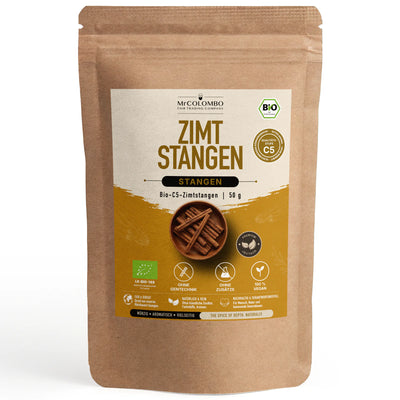
For savoury dishes, what matters is less the origin than the question of how the aroma behaves over a long cooking time. Ceylon cinnamon from Sri Lanka tastes delicate, floral and slightly citrusy. It settles beneath lamb stock, tomato and cumin without drowning them out, and stays in the background even after two hours in the casserole. Cassia cinnamon brings a sharper, almost woody profile and quickly pushes itself to the fore in a savoury dish, where it masks the other spices.
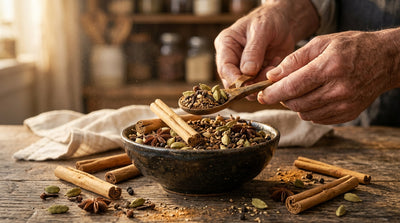
More important than the variety in savoury cooking is the form: a whole stick releases its aroma evenly into the stock over hours and can be removed again before serving. Ground cinnamon dissolves completely straight away, can no longer be corrected and turns bitter if cooked for too long. All five recipes in this article therefore work with whole sticks.
How Ceylon and cassia cinnamon differ botanically, how far apart their coumarin content lies and how you can recognise true Ceylon cinnamon when shopping is something we have set out in detail in our article on coumarin in cinnamon.
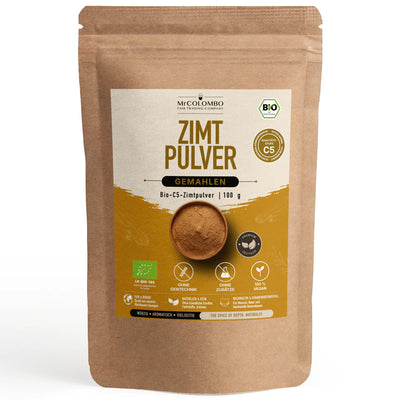
At MrCOLOMBO, our Ceylon cinnamon sticks come from the central region of Sri Lanka in quality grade C5 (Continental Grade 5), one of the highest-quality official Sri Lankan cinnamon grades. We know the cooperatives that peel the bark by hand and roll it into the characteristic multi-layered sticks, directly and without intermediaries. This direct trading relationship allows us to trace the origin and processing quality of every batch before it is shipped to Germany. Ceylon cinnamon is thus Sri Lanka's second-largest agricultural export after tea, covers around 90 per cent of the global market for true cinnamon and secures the livelihoods of more than 70,000 smallholder families (IFC and Export Development Board, 2024) - precisely the cooperatives we work with directly.
How do you make a Persian lamb khoresh with cinnamon and aubergine?
Khoresh bademjan is a classic Persian stew of lamb, fried aubergine, tomatoes, turmeric and a whole cinnamon stick that has been prepared in Iran's everyday cooking for generations. The meat is first seared, then braised with onions, turmeric and the cinnamon stick over a low heat for around 90 minutes until it is meltingly tender (Unicorns in the Kitchen). The fried aubergine slices are only added in the last half hour so that they keep their shape and do not fall apart. Traditionally, the dish is served with saffron rice, which further accentuates the earthy sweetness of the cinnamon.
The link between cinnamon and Persian cuisine goes back a long way historically: as early as the Achaemenid Empire (550 to 330 BC), cinnamon was among the spices of courtly banquets (Let's Go Leafy). To this day, this tradition lives on in the spice blend advieh, which unites cinnamon, turmeric, ginger and cumin and is used equally for sweet and savoury dishes. Anyone recreating khoresh bademjan should opt for a whole cinnamon stick rather than powder: it releases its aroma slowly during the 90-minute braising time without letting the dish turn bitter, and can simply be removed again before serving.

What does a Moroccan vegetable tagine with cinnamon and ras el hanout taste like?
The Moroccan tagine owes its name to the clay pot of the same name with its cone-shaped lid, whose form collects the rising steam and lets it drip back down onto the food. A classic vegetable tagine combines cinnamon with cumin and coriander, plus carrots, chickpeas and dried apricots, which soften in their own steam during the long cooking time (The Mediterranean Dish). The sweetness of the apricots and the rounded warmth of the cinnamon balance out the heat of the other spices without any additional sugar being needed.
Many Moroccan tagines additionally build on ras el hanout, a spice blend whose name literally means "head of the shop" and historically denoted a spice merchant's finest selection (Spice Station Silver Lake). Depending on the merchant, ras el hanout can contain between 12 and more than 30 individual spices, with cinnamon almost always forming one of the core components alongside ginger, turmeric and pepper (Feasting at Home). For home cooking, a simpler combination is often enough: a cinnamon stick, ground cumin and coriander, complemented by a pinch of chilli for heat.

How do you make Chinese five-spice chicken with cinnamon?
Chinese five-spice powder (wuxiangfen) classically consists of star anise, cinnamon sticks, cloves, fennel seeds and Sichuan pepper, which are dry-roasted separately and then finely ground together (China Sichuan Food). For a glazed five-spice chicken, the powder is stirred together with soy sauce, honey, rice vinegar and ginger into a sticky marinade in which the chicken pieces steep for at least 30 minutes before they caramelise in the oven. This "Sticky Chinese Five Spice Chicken" has been one of the consistently sought-after recipes from Marion's Kitchen since it was first published in 2018.
According to historical sources, the origin of the five-spice blend probably reaches back to the Chinese Han dynasty (206 BC to AD 220) and follows the theory of the five elements, which was meant to bring the flavours into balance with yin and yang. Originally, the blend served medicinal rather than culinary purposes before it established itself as a seasoning base for roasts, soups and marinades. Important for home cooking: if too much cinnamon is used in proportion to the other four spices, the aroma quickly tips towards sweet pastry instead of savoury depth, which is why cinnamon should usually make up only one fifth of the total amount. Anyone generally interested in the variety of Asian spice blends will find an overview in our article on Asian spices.
How do you make a Sri Lankan coconut curry with Ceylon cinnamon?
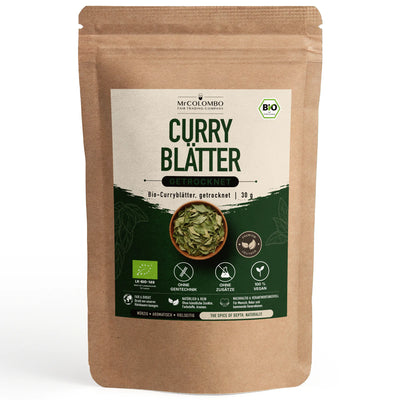
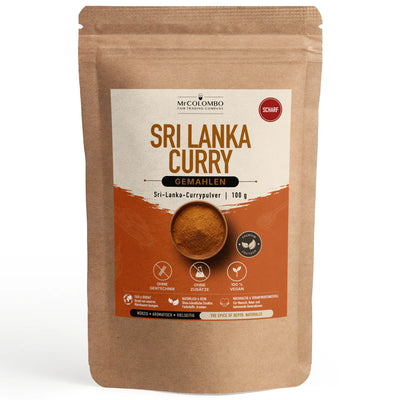
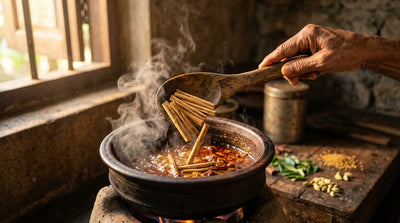
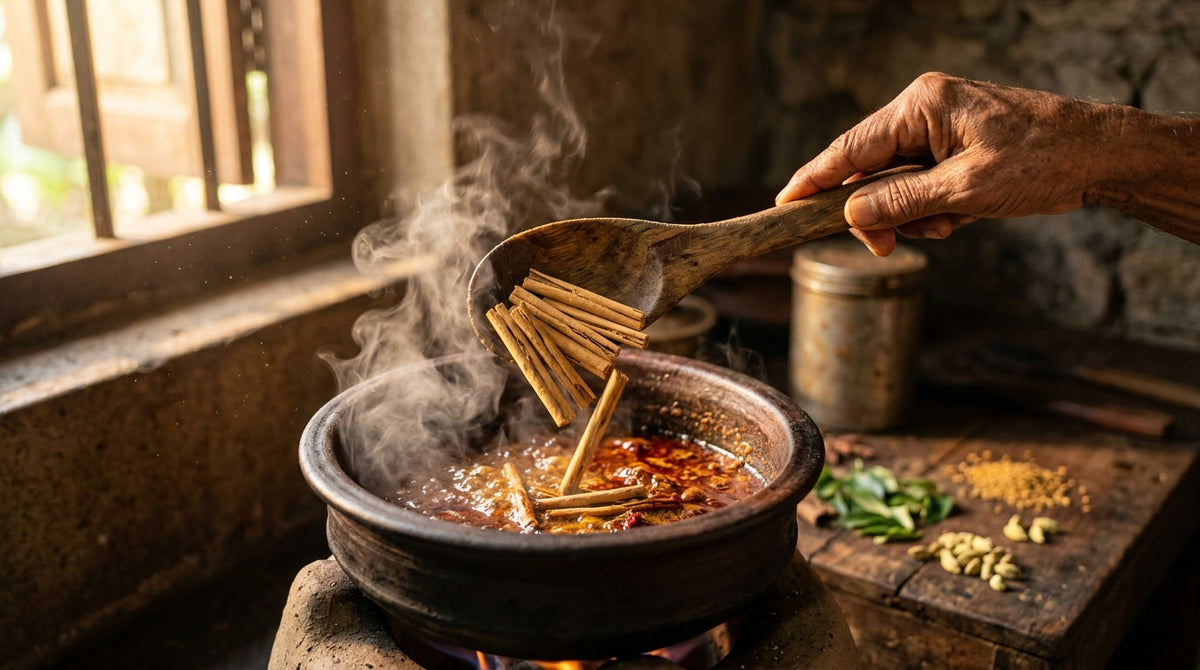
A traditional Sri Lankan chicken curry begins with frying curry leaves, onions and a whole Ceylon cinnamon stick in hot oil before the coconut milk and the meat are added (The Flavor Bender). What matters here is expressly Ceylon cinnamon rather than cassia cinnamon, since the cinnamon stick stays in the pot for the entire cooking time and releases its aroma continuously. The order is decisive: curry leaves and cinnamon stick go into the hot oil first, and only then do coconut milk and meat follow. It is precisely this tempering at the start that distinguishes this version from the classic, long-braised lamb version with cinnamon stick that we have already described in our Ceylon cinnamon recipes. The mild, slightly lemony sharpness of the curry leaves combined with the warm sweetness of Ceylon cinnamon produces the characteristic aroma that sets Sri Lankan curries apart from Indian or Thai versions. Anyone looking for the right base for an authentic curry will find it in our range of Sri Lanka curry powders.
At the street food markets around Kandy, the cinnamon stick does not end up in the dessert but first in the curry pot.
MrCOLOMBO experience report
In many families in Sri Lanka, for instance in the coastal regions around Galle, cinnamon rice is additionally served as a side dish: basmati rice steamed in ghee together with a cinnamon stick, cardamom pods and cloves before it is served with the curry (Burlap & Barrel). On our trips to the partner farms in the Central Province, we have seen how naturally whole cinnamon sticks end up in almost every savoury dish, from curry paste to rice dishes, while ground cinnamon remains reserved almost exclusively for sweet uses.

How do you prepare a cinnamon biryani using the dum method?
In a classic North Indian chicken or lamb biryani, basmati rice is par-cooked separately from the meat and the two are then stacked in layers in a pot, together with a whole cinnamon stick, garam masala, saffron and fried onions (Cinnamon and Coriander, in German). In the so-called dum method, the pot is then sealed airtight, usually with a rim of dough, and cooked over a low heat so that rice and meat permeate each other with aroma. The cinnamon stick cooks along the whole time and is only removed from the rice when serving.
Anyone comparing the Persian, Moroccan and Indian uses from this article will recognise a recurring pattern: wherever cinnamon is used in savoury cooking, it is almost exclusively the whole stick that is used, not the powder. Our Sri Lankan curry recipe shows this too: whole sticks release their aroma slowly over the entire cooking time, while powder burns more quickly and can turn bitter if it is added to the fat too early and at too high a heat.
Why is cinnamon worth it beyond the breakfast table?
In at least five international cuisines, cinnamon belongs to savoury dishes as naturally as it does to sweet baking: from Persian lamb khoresh via Moroccan tagines to Chinese five-spice chicken, Sri Lankan coconut curry and North Indian biryani. Scientifically, this can be explained by cinnamaldehyde, which, with the highest measured aroma value of all cinnamon constituents (OAV 935), shapes both the scent and the perception of "rounded" sweetness, entirely without sugar. In practice, the route always leads via the whole stick rather than powder: it releases its aroma evenly into the stock over the entire cooking time and leaves the pot again before serving. Anyone who would like to discover the sweet side of Ceylon cinnamon alongside the savoury uses will find further ideas in our Ceylon cinnamon recipes and in our in-depth article on coumarin in cinnamon.


