






Classic gingerbread spice consists of cinnamon, cloves, cardamom, ginger, nutmeg, allspice and coriander in a ratio of roughly 25 g of cinnamon to around 20 g of the remaining spices (Ökotest). Which blend really fits, however, depends on the dough: brown gingerbread (Braune Lebkuchen) can take a robust seasoning, while nut-rich Elisenlebkuchen needs a finer dosage so that the almond and hazelnut aroma is not masked.
At MrCOLOMBO we blend our gingerbread spice with Ceylon cinnamon (Cinnamomum verum) from the central region of Sri Lanka, where, according to the Sri Lanka Export Development Board, around 90 per cent of the world's Ceylon cinnamon is grown. The cinnamon trees for our blend come from the growing areas of the Central Province, Matale and Kandy, where a warm, humid climate of 20 to 30 degrees Celsius and lateritic, well-drained soil create ideal growing conditions. The thin inner bark is harvested by hand and then air-dried in fine quills, a laborious process that gives the cinnamon its mild, slightly sweet aroma and clearly sets it apart from the sharper, more robust cassia cinnamon, which is usually processed by machine. Anyone who makes the blend themselves decides not only on the aroma but also on which type of dough and which maturing time will ultimately deliver the best result, two questions that hardly ever come up in most recipes online.
Short answer
How do you make gingerbread spice to suit the type of dough? The base blend of cinnamon, cloves, cardamom, ginger, nutmeg, allspice and coriander (Ökotest ratio: 25 g of cinnamon to around 20 g of the remaining spices) suits brown gingerbread in a robust dosage and Elisenlebkuchen in a more restrained one. Timing is also important: the spices belong in the dough before the weeks-long maturing of the dough, not just shortly before baking.
At a glance
How much cinnamon, cloves and cardamom does the classic recipe need?
The base is formed by seven spices: cinnamon, cloves, cardamom, ginger, nutmeg, allspice and coriander. According to the Ökotest recipe, the ratio is 25 g of cinnamon, 2 to 3 g of cloves, 4 to 5 g of cardamom, 4 to 5 g of ginger and 3 g each of nutmeg, allspice and coriander. Thomas Sixt blends somewhat more robustly with 30 g of cinnamon to 12 cloves, 5 g of cardamom, 4 g of nutmeg, 5 g of allspice, 3 g of coriander and 3 g of aniseed, while Smarticular.net calculates for small quantities without kitchen scales: 2 teaspoons of cinnamon to 1 teaspoon of cloves plus half a teaspoon each of cardamom, nutmeg and aniseed. Nutmeg is always used only in small quantities of a few grams, as is customary in all three recipes. This range shows that there is no single correct ratio: anyone working with kitchen scales can reproduce any of the three recipes exactly and, if needed, adjust individual spices for the next batch without losing the character of the blend.
The type of cinnamon deserves a second look: according to an analysis of 60 market samples, true Ceylon cinnamon contains on average only around 0.004 per cent coumarin, whereas commercially available cassia cinnamon contains up to 1 per cent (Blahova, Svobodova, 2012). A detailed comparison of both types of cinnamon with all measured values can be found in the article Ceylon cinnamon and coumarin compared. Anyone torn between a ready-made spice blend and mixing it themselves from single spices will find a detailed comparison in the article Spice blends versus single spices.

Which gingerbread spice suits which type of dough?
According to the German guidelines for fine baked goods (Leitsätze für Feine Backwaren), the classic types of gingerbread differ markedly in composition and texture, and this is precisely what determines the appropriate seasoning (Verbraucherfenster Hessen). Brown gingerbread is a kneadable dough with a high flour content, sweetened with honey or syrup and baked without a wafer base. Because the flour body is more robust, it can also take the most dominant seasoning of the entire blend. Elisenlebkuchen, on the other hand, contains at least 25 per cent nuts such as almonds or hazelnuts, at most 10 per cent flour, and is baked on a wafer, which is why a finer dosage is called for here that does not mask the nut aroma. The wafer plays its own role in this: it absorbs moisture and prevents the nut-rich dough from sticking to the baking tray, while at the same time keeping the seasoning closer to the palate than with wafer-free brown gingerbread. For both types of dough the same applies: anyone who adjusts the amount of spice to the fat and sugar ratio of the particular recipe avoids the seasoning getting lost in the finished bake or seeming too dominant.
| Dough type | Characteristic | Seasoning |
|---|---|---|
| Brown gingerbread | High flour content, sweetened with honey or syrup, without wafer | Robust, dominant seasoning possible |
| Elisenlebkuchen | At least 25 % nuts, at most 10 % flour, on a wafer | Fine seasoning, nut aroma must not be masked |
| Honey cake | Sweetening at least 50 % from honey | Less cinnamon needed, honey note contributes |
| Printen, Pfeffernüsse | Subgroups of brown gingerbread | Robust, sometimes sharper seasoning with more ginger and allspice |
Honey cake draws at least half of its sweetness from honey, which means the amount of cinnamon in the spice blend can usually be reduced somewhat, because the honey note itself already brings warmth and depth. Printen and Pfeffernüsse are regarded as subgroups of brown gingerbread and are traditionally seasoned more robustly and sometimes more sharply, with a higher proportion of ginger and allspice. Anyone wanting to make a single blend for all types of dough does best with the Ökotest base recipe and simply adjusts the dosage per kilogram of dough to the particular dough type.
Why does gingerbread dough have to mature for weeks before baking?
Classic storage dough traditionally rests for several weeks at around 12 degrees, at least 3 days as an absolute minimum; for brown gingerbread 4 to 6 weeks is the guideline, sometimes up to 8 weeks. The reason is chemical, not just aromatic: many traditional gingerbread doughs are leavened with potash (potassium carbonate) rather than baking powder or yeast, and potash needs acid in order to develop its leavening power at all. During storage, lactic and acetic acid form in the dough, and together with the acid of the honey these are what actually bring about the leavening of the dough (Verbraucherfenster Hessen). Without this acid formation, the dough remains firm and compact after baking instead of light and crumbly, which is why impatiently shortening the resting time can be seen directly in the texture. A cool, evenly tempered storage place matters more here than absolute cold: if the temperature fluctuates strongly, acid formation proceeds unevenly and parts of the dough mature more slowly than others.
For the spice blend, this results in a clear timing: it belongs in the dough before maturing, not just shortly before baking. During the weeks-long storage time, the essential oils from freshly ground cinnamon, cloves and cardamom penetrate deep into the dough and distribute themselves evenly. A blend that is only stirred in immediately before baking stays on the surface and tastes noticeably flatter than a dough that has been allowed to mature with the spices for weeks. This waiting time is one of the main reasons why traditional gingerbread bakeries start making their dough as early as late summer.
Our way at MrCOLOMBO
We grind Ceylon cinnamon only shortly before dispatch so that as much essential oil as possible is retained before the blend even goes into the dough. How to store spices properly in general is explained in detail in the article Storing spices properly.

How do you roast and grind whole spices for gingerbread spice?
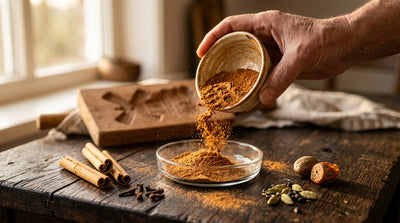
Anyone working with whole spices instead of ready-made powder can briefly toast them in a dry pan before grinding, which intensifies the aroma further, before a mortar or electric grinder turns them into a fine powder. Specific temperature or time figures for this cannot be reliably substantiated, which is why we leave it at this general description. For the grinding itself, Thomas Sixt recommends an electric grinder rather than a mortar, because it delivers a more even powder, while the mortar allows finer control over the degree of grinding for small quantities.
This origin is more than an advertising promise: we buy our Ceylon cinnamon directly from organic-certified smallholder cooperatives, with no middlemen between the plantation and dispatch to Germany. Every delivery is checked against the national quality standard SLS 81:2021, which for the Alba trade grade prescribes a maximum residual moisture of 15 per cent as well as limits for pesticides and heavy metals. Alongside Alba, the standard distinguishes the trade grades Mexican and Hamburg, with Alba, having the smallest diameter and the mildest aroma, regarded as the highest-quality grade and used exclusively in our blend. Only bark that meets these values goes into our grinder at all, before it travels freshly ground into the gingerbread spice blend. This chain of checks is one of the reasons why direct import from Sri Lanka means more in practice than a note of origin on the label, namely traceability down to the individual cooperative and a consistent quality from delivery to delivery, which is also reflected in the taste of the finished spice blend.
Checklist for preparation
Type of cinnamon checked? Look for the label "Ceylon cinnamon" or the botanical name Cinnamomum verum, otherwise the jar usually contains cassia cinnamon.
Whole spices freshly ground? Grinding only shortly before blending retains considerably more essential oil than ready-ground goods that have already sat on the shelf for weeks (Smarticular.net).
Grinder used only for spices? A separate spice grinder prevents foreign aromas such as coffee from transferring to the blend.
Spices worked in before the dough matures? Only then do the essential oils fully penetrate the dough during the weeks-long storage time.
How do you make a supply for the whole Advent season?
For the entire Advent season, a larger batch is worthwhile: anyone who doubles or triples the Ökotest recipe ends up with enough spice blend for several baking days without having to mix a new batch in between. Stored airtight, dark and cool in a sealed screw-top jar, the finished blend keeps for up to 6 months (Taste of Home, 2024), but steadily loses aroma intensity, as essential oils evaporate over time (Smarticular.net). For the best flavour, a fresh blend at the start of each Advent season is therefore preferable to a supply from the previous year.
A larger batch is also suitable as a gift idea: small portion jars with hand-written labels are a recurring DIY format for nursery teachers, teachers and colleagues, described in several German-language guides for the Advent season. The same principle applies to your own supply as to gift jars: the fresher the spices when blending, the longer the aroma is retained even in the sealed jar. The right ingredients for this, from Ceylon cinnamon to nutmeg, can be found in our Spices range.

How did the Nuremberg gingerbread tradition develop, and how do the regions differ?
The Nuremberg gingerbread tradition goes back to 1395, when "Lebküchner" (gingerbread makers) were first mentioned in the city's tax registers. In 1487, Emperor Frederick III is said to have distributed gingerbread during a visit to Nuremberg, an early testimony to the significance of the pastry in courtly circles. In 1643, the Nuremberg gingerbread makers' guild was founded with 14 members, shaping quality and recipes over centuries (BDSI). Since 1808, Elisenlebkuchen with at least 25 per cent nut content has been regarded as the highest-quality variety, today protected by the RAL quality mark RAL-RG 0131 and recognised since 1996 as a protected geographical indication (PGI).
Nuremberg gingerbread production was made possible by the city's location on important trade routes: via the axis of Venice, Augsburg, Nuremberg, Leipzig and Novgorod, cinnamon, cloves and nutmeg reached the imperial city as early as the High Middle Ages (Historisches Lexikon Bayerns). Besides Nuremberg, other regions have preserved their own gingerbread traditions, such as the Aachener Printen with their characteristically more robust seasoning, sometimes reminiscent of brown sugar beet syrup. In 2023, according to the Federal Statistical Office, German manufacturers produced around 86,800 tonnes of gingerbread, honey cake and Printen combined, evidence of how firmly this baking tradition remains anchored in German Christmas baking to this day (Destatis, 2024).
How does German gingerbread spice differ from speculaas and pepparkakor?
German gingerbread spice sets cinnamon as the clear base with cloves, cardamom and ginger as companions, while the Dutch speculaaskruiden blend, in a ratio of 8 teaspoons of cinnamon to 2 teaspoons of cloves and 1 teaspoon of ginger, remains similarly cinnamon-dominant (The Dutch Table, 2024). The Swedish pepparkakor seasoning, by contrast, reverses the ratio and puts ginger in the foreground.
Pepparkakor recipes combine ginger, cinnamon, cardamom and cloves, sometimes supplemented by a pinch of black pepper, and in their basic form go back to a version from 1755 (RawSpiceBar). Speculaaskruiden often adds nutmeg, mace and white pepper to the base, which gives the blend a spicier, slightly peppery note. All three traditions, German, Dutch and Swedish, use the same basic spices from historical long-distance trade; only the weighting and the cinnamon share differ from country to country.
Why does home-made gingerbread spice with Ceylon cinnamon win you over?
Home-made gingerbread spice wins you over for two reasons: it can be tailored exactly to the particular type of dough, more robust for brown gingerbread and Printen, more restrained for Elisenlebkuchen, and with Ceylon cinnamon as the base the coumarin content of the blend stays at around 0.004 per cent, well below the value for cassia cinnamon (Blahova, Svobodova, 2012). Anyone who takes the Ökotest recipe as a starting point, works the spices in before the weeks-long maturing of the dough and grinds them fresh avoids the uncertainty that remains with anonymous ready-made blends.
For anyone wishing to experiment with Ceylon cinnamon beyond gingerbread, it is worth taking a look at our collection of Ceylon cinnamon recipes. There you will find further ideas for use, ranging from baked goods to savoury dishes, that make use of the mild, low-coumarin character of true cinnamon.


